If you built an AI agent on agent.ai, you now have a fixed date to work against. According to the agent.ai user milestone announcement on simple.ai (2025), the platform grew from 47,000 users at launch to more than 2 million. A user base that size does not disappear quietly. It relocates.
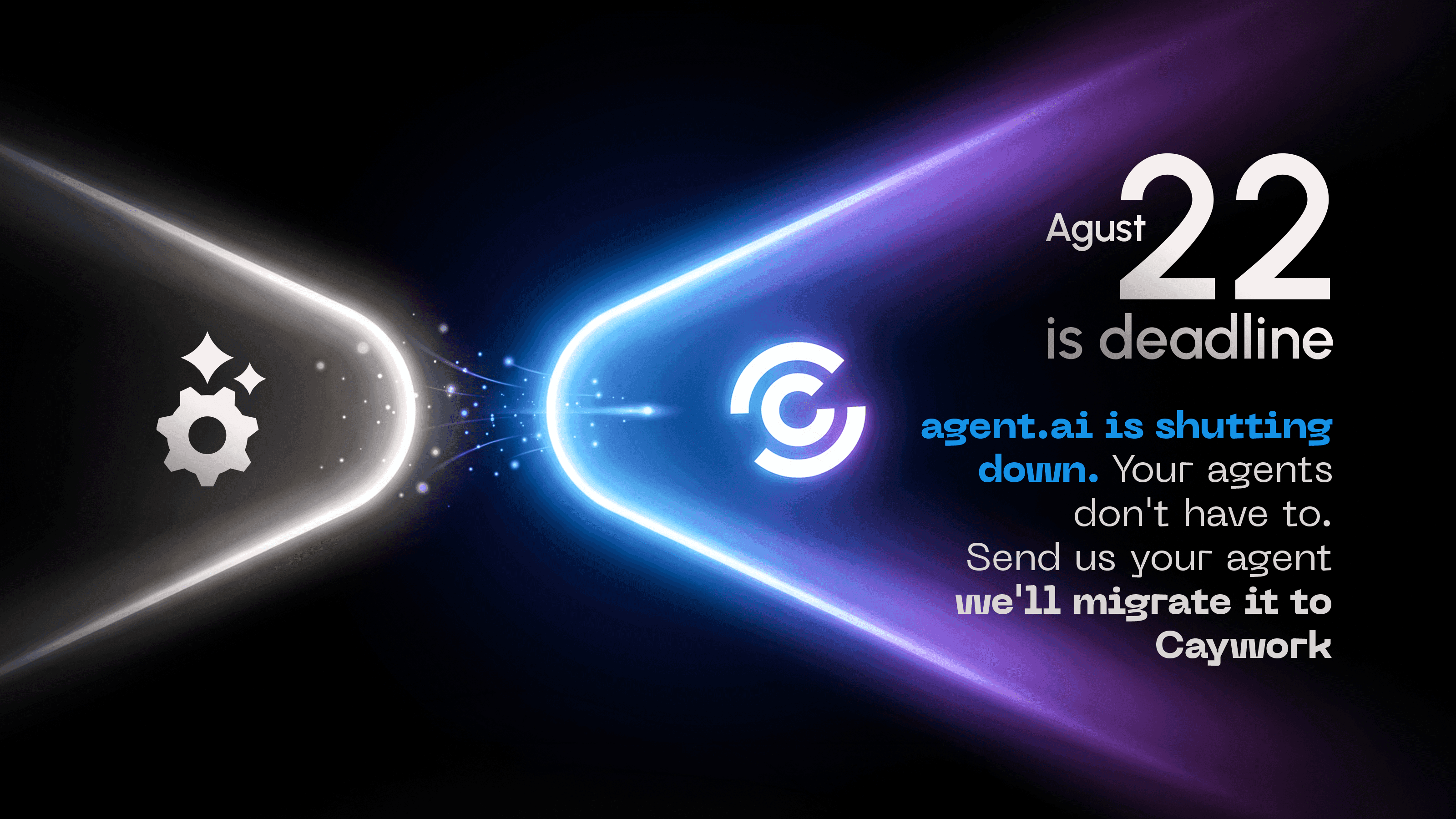
The date is August 22, 2026. After that, agent.ai stops operating as a standalone marketplace and its agent technology continues inside HubSpot. There is no announced migration path for creator listings. That single detail is the reason this article exists, because it changes what you should be doing between now and August from transferring to rebuilding.
This guide covers the timeline, the structural reasons behind the closure, what the shutdown means specifically for creators rather than casual users, and a checklist for picking a replacement. It also states plainly where the alternatives fall short, including Caywork.
The August 2026 Shutdown and HubSpot Absorption
The timeline is short. Agent.ai launched as an open beta, grew quickly, and is scheduled to close on August 22, 2026, with its technology absorbed into HubSpot.
The volume of work involved is the reason creators should care more than casual users do. The same simple.ai announcement (2025) reported that more than 44,000 agents had been built on the platform. Each one carries configuration, prompt work, testing, and in many cases a public listing with an audience attached to it.
Three structural reasons explain the closure, based on the pattern rather than on any insider statement:
- Agent.ai ran as a side project and research sandbox, not as a revenue-first product with long-term platform commitments.
- HubSpot needed proven agent technology quickly, and acquiring working technology is faster than building it.
- Standalone agent marketplaces are losing ground to agent features embedded inside software customers already pay for.
None of that reflects on the quality of what you built. All of it is structural, which is precisely why the same sequence can repeat on whichever platform you pick next.
Why Standalone Marketplaces Are Losing to Embedded CRMs
To see where this technology is heading, look at what HubSpot already shipped. The HubSpot AI agents guide from tldv.io (2024) describes how HubSpot placed AI agents directly inside its CRM, so marketing and sales tasks could be automated without reaching for outside tools. A CRM, or customer relationship management system, is the software a business uses to store customer records and manage deals.
That design carries a benefit and a cost in the same sentence. tldv.io (2024) notes that HubSpot's Breeze agents are built into the CRM and therefore require no third-party integrations, but they are tied to the HubSpot ecosystem.
Read the trade-off carefully, because it explains the entire situation. For an existing HubSpot customer, agents inside the CRM are convenient. For an independent creator, an agent that only runs inside one company's CRM is not a product you own and distribute. It is a feature inside someone else's software.
That is the difference between a marketplace and an ecosystem. A marketplace exists to give independent builders distribution. An ecosystem exists to make one platform harder to leave. When a marketplace is absorbed into an ecosystem, the independent builders are usually the part that does not travel.
Where Every Option Falls Short
This section is not going to flatter anyone.
Start with the hard constraint. There is no announced export or migration route for agent.ai marketplace listings. Your configurations, your listing page, your reviews, and your audience do not move automatically. Plan on rebuilding from your own notes.
The alternatives bring their own friction. The Marketer Milk platform roundup (2026) points out that standalone platforms often require complex integration work before anything runs end to end, using Make as its example, where a complete workflow means chaining connections through the platform's app library. Ease on a marketing page is not the same as ease on day one.
Technical difficulty is the second constraint. The LiveChatAI builder comparison (2026) observes that many agent builders carry a steep learning curve for people who are not developers, because they assume comfort with APIs and code. An API is the connection point that lets two software tools exchange information. If that definition was useful to you, treat learning curve as a primary selection criterion rather than a detail.
There is also a limit on what any platform can promise, and that includes Caywork. No company can guarantee it will still be operating in five years, and any platform claiming otherwise is selling rather than informing. What a platform can do is structure itself so that its revenue depends on creators rather than on being acquired for its technology. That is a difference in design and incentives, not a guarantee, and you should evaluate it as one.
A Practical Checklist for Choosing Your Next Platform
Work through these before you rebuild anything.
- Who is the paying customer? If creators pay the bills, creator distribution survives budget decisions. If creators are a funnel toward enterprise contracts, the marketplace is the first line item cut.
- Is it tied to a single CRM or vendor? Neutrality is the point of leaving. Marketer Milk (2026) treats integration breadth as a core evaluation factor, noting that Make offers more than 3,000 pre-built integrations connecting major language models to tools such as Slack and Notion. Breadth is a reasonable proxy for independence.
- Can you get your work out? LiveChatAI (2026) identifies avoiding vendor lock-in as a leading advantage of platform-agnostic builders, meaning builders not bound to one vendor's stack. Ask about export before you build, not after.
- Can you ship without writing code? If the honest answer is no, budget the learning time or choose differently.
- Is there actual distribution? A builder with no audience attached is a private tool. A marketplace with active users is a business.
- What happens to your listing in an acquisition? Ask the question directly. A vague answer is still an answer.
Caywork is positioned on the neutral side of the first three items. It is a marketplace and creator platform for AI agents that is not attached to a CRM, which means published agents function as products with an audience rather than as features inside a sales suite. It is not a copy of agent.ai. It is an attempt to preserve the part creators valued most, which was open distribution for independent builders. Evaluate it against the same six questions you apply to everything else.
Where Independent Agent Building Goes From Here
The likely outcome over the next few years is a split market rather than a single winner. Large software companies will keep embedding agents inside their own products for their own customers, and that will serve those customers well. Independent creators will still need at least one neutral venue where an agent can reach people who are not already paying for a specific CRM. Those two models serve different buyers and can coexist.
You can create full data export from the agent.ai website. Once you have the exported data, Caywork will help you rebuild. Submit your agent export, configuration, or prompts through our contact form or email us directly, and we will manually recreate your agents on Caywork.
When you are ready, start building your creator presence at caywork.com/creator. One agent, one week, and you will be deciding with evidence instead of a deadline.
Sources
- simple.ai (2025). "Agent.AI Just Hit 2 Million Users!" https://simple.ai/p/agent-ai-just-hit-2-million-users
- tldv.io (2024). "HubSpot AI Agents: Complete Guide." https://tldv.io/blog/hubspot-ai-agents
- Marketer Milk (2026). "13 best AI agent platforms & builders I'm using in 2026." https://www.marketermilk.com/blog/best-ai-agent-platforms
- LiveChatAI (2026). "AI Agent Builders." https://livechatai.com/blog/ai-agent-builders